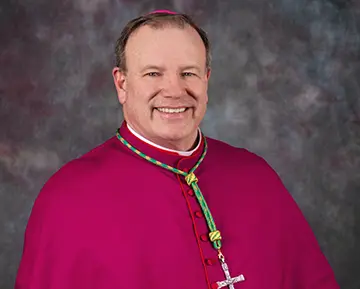
by Bishop Robert W. Marshall, Jr. One of the earliest surviving descriptions of Christian worship comes from the First Apology of St. Justin Martyr. It was written in approximately 155 A.D. and was addressed to the Roman Emperor Antoninus Pius. You can find a large portion of the text in the Catechism of the Catholic …

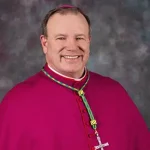
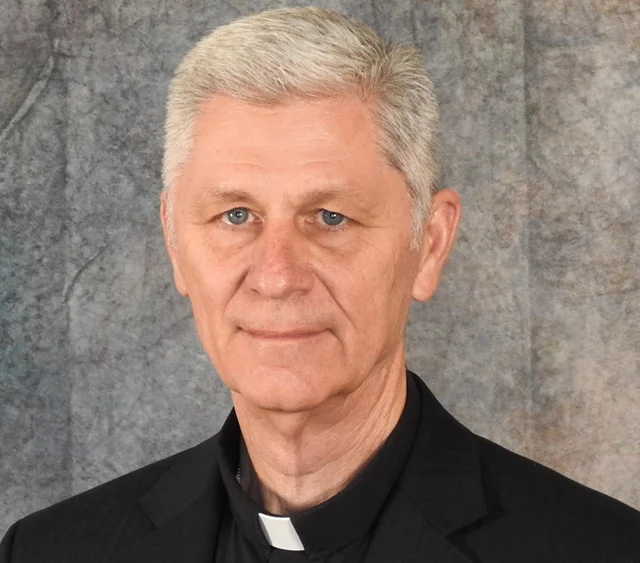
by Bishop Robert W. Marshall, Jr.
One of the earliest surviving descriptions of Christian worship comes from the First Apology of St. Justin Martyr. It was written in approximately 155 A.D. and was addressed to the Roman Emperor Antoninus Pius. You can find a large portion of the text in the Catechism of the Catholic Church, ¶1345. His description begins: “On the day we call the day of the sun, all who dwell in the city or country gather in the same place.” He continues with a description of a liturgical service that we would easily recognize as Mass. From the earliest days of the Church, Christian communities came together on Sunday to hear and reflect upon the word of God and to share in the Most Holy Body and Blood of Christ – bread and wine over which the leader of the assembly gives thanks “for a considerable time.” St. Justin uses the Greek word for giving thanks – eucharistian – to describe this prayer. St. Justin’s words are notable – not only as a historical record of Christian worship – but as evidence of the unity to be found in the early Church – “all who dwell in the city or country gather in the same place.”
To this day, Catholic Christians gather for Mass each Sunday, not in the same place though. Instead, we gather in numerous locations in cities and towns – some Catholic churches are even within walking distance of each another. We also gather in small groups three or four or more times during each Sunday – not because we cannot all fit in the worship space at the same time, but because we have come to expect worship that is convenient to our schedule or our personal preferences. Rather than the single celebration that characterized the early Church, we are divided into small groups that may not fill even one-fourth of the building’s seating capacity at each celebration. Too often parishioners in the same church do not know each other; they only know those who sit near them at “their” Mass.
This situation developed when vocations to the priesthood were plentiful. Each priest was required to celebrate one Mass on Sunday. Indeed, they were limited to celebrating only one Mass on Sunday except with the permission of the diocesan bishop. Most bishops permitted priests to celebrate two Sunday Masses. Parish schedules were established with this in mind. If a parish had three priests, for example, they could have six Masses. When all Sunday Masses could only be celebrated in the morning, that often meant a crowded schedule. In the early 1960s, for example, my home parish, St. Michael Church in Memphis, had three priests and our Mass schedule was 6:00am, 7:30am, 9:00am, 10:30am and 12 noon. That schedule was necessary as our church was small – it would eventually be repurposed as the school gym. In 1963, a new, larger church was dedicated. The seating capacity of the new church was approximately 1,000 whereas the old church accommodated only about 200. And yet, eight years after we moved into the new church, our Mass schedule still included the same five Masses, even though we had only two priests. Except on Christmas and Easter Sunday morning, we were never even close to filling the new church. Why did the parish not take advantage of the new, larger church and reduce the number of Masses? Because many of our parishioners were inflexible. The 6:00am crowd were steadfastly opposed to going to a later Mass, while the Noon crowd could not imagine getting up any earlier.
When Saturday anticipatory Masses became permissible, some of the earlier Masses lost their appeal, but the one-hour Communion fast brought pressure to add Sunday afternoon and evening Masses. And yet, as Masses were added, ordinations to the priesthood were dropping. Bishops were forced to grant permission to priests to celebrate three or four or more Masses each Sunday just to meet the demands of their congregations. Is there any wonder why we often scramble to find a priest to celebrate Mass when one of our priests gets sick?
Sisters and brothers, when we go to a wedding feast, we either adjust our schedule to be at the wedding and the reception on time or we send our regrets. We do not expect the bride or groom to repeat their vows several times on their wedding day in order to make their celebration most convenient to us. Each Sunday, we are invited to the wedding feast of the Lamb. We come together to receive the Body of Christ and to become the Body of Christ. In a church with a seating capacity of 300, do we really need four Masses attended by only 60 people each? Candidly, do we make Mass the high point of our Sunday and adjust our schedules accordingly? Or do we make our personal schedule first and then find a Mass that fits – and do not go if one does not.
The early Church faced many challenges. Within 10 years of writing his First Apology, St. Justin had been martyred during the reign of Emperor Marcus Aurelius. Even in the face of persecution, the early church persevered. Today, most of us do not face persecution or death – and yet we do not even risk inconvenience in order to practice our faith.
Canon law is clear. Except as otherwise permitted by law, “[a] priest is not permitted to celebrate the Eucharist more than once a day.” (Canon 905 §1). That same canon provides “If there is a shortage of priests, the local ordinary [i.e., the bishop] can allow priests to celebrate twice a day for a just cause, or if pastoral necessity requires it, even three times on Sundays and holy days of obligation.” (Canon 905 §2). Clearly, we have a shortage of priests, so there is a just cause for each priest to celebrate two Masses on Sunday (and often on other days in the case of a funeral Mass or a wedding Mass, for example). As bishop, however, I must determine whether there is a true pastoral necessity that would require a priest to celebrate more than two Masses on Sunday on a regular basis.
In the month of September, each parish and mission in the Diocese of Alexandria will conduct a count of those attending each weekend Mass. If the number of Masses is reasonable for the combined size of the congregations and the seating capacity of the church, then any changes would be merely an opportunity to evaluate the quality of the liturgy in light of the mission of the Church. If, however, the schedule of a parish requires a priest to celebrate three or more Masses each Sunday on a regular basis (i.e., not in an emergency because a brother priest is sick, for example), then I must determine that there is a true pastoral necessity, namely that the attendance at each Mass regularly exceeds approximately 75% of the seating capacity of the church. If the combined Sunday congregation of a given parish at all of its Masses could easily fit into one or two Masses, then, as bishop, I will step in by withdrawing the permission in that parish for additional Masses of convenience – as there would be no pastoral necessity.
I know that we want happy, holy and healthy priests, not those who are over-burdened and exhausted. I invite you to prayerfully consider whether you could be more flexible by participating in Mass at a different time rather than asking our priests to retain a full schedule of Masses that are unnecessary, repetitive, and are not justified by a true pastoral necessity.